
If you’re wondering how much a down payment on a house is, the answer depends on the loan program you choose and your financial situation.
In 2026, most buyers put down 3% to 20% of the home’s purchase price. However, some government-backed loans allow 0% down, while jumbo loans may require 10% to 20% or more.
Let’s break it down clearly so you know what to expect.
How Much Is a Down Payment on a House in 2026?
What Is a Down Payment?
A down payment is the cash payment made at closing towards purchasing a home, typically combined with loan funds to cover its full purchase price. Down payments are expressed as a percentage of this total cost.
For instance, a 10% down payment on a $300k home would represent making 10% down. Once purchased, the remaining balance can usually be borrowed against and paid back over time through monthly principal and interest repayment payments.
Do You Have to Put Down 20% When Purchasing a House?
While searching for how much is a down payment on a house, you may come across this question. A 20% down payment may be ideal. However, 58% of mortgage buyers in 2022 reported making down payments of less than 20% when purchasing homes.
Though not required, setting aside 20% can bring several key advantages:
- Lower monthly payments due to borrowing less overall.
- Better interest rates and loan terms.
- Conventional loans with no PMI fees.
- Stronger offers in competitive real estate markets
- More equity in the home you are buying.
Look at how much equity can be added by increasing the down payment on a $350,000 home by choosing to put 20% rather than 5% down, using a 30-year fixed-rate mortgage with an interest rate of 5%, and using 30-year amortization instead of amortization for payments of just 5% down versus 20. It could save over $700 monthly!
Minimum Down Payment For A House
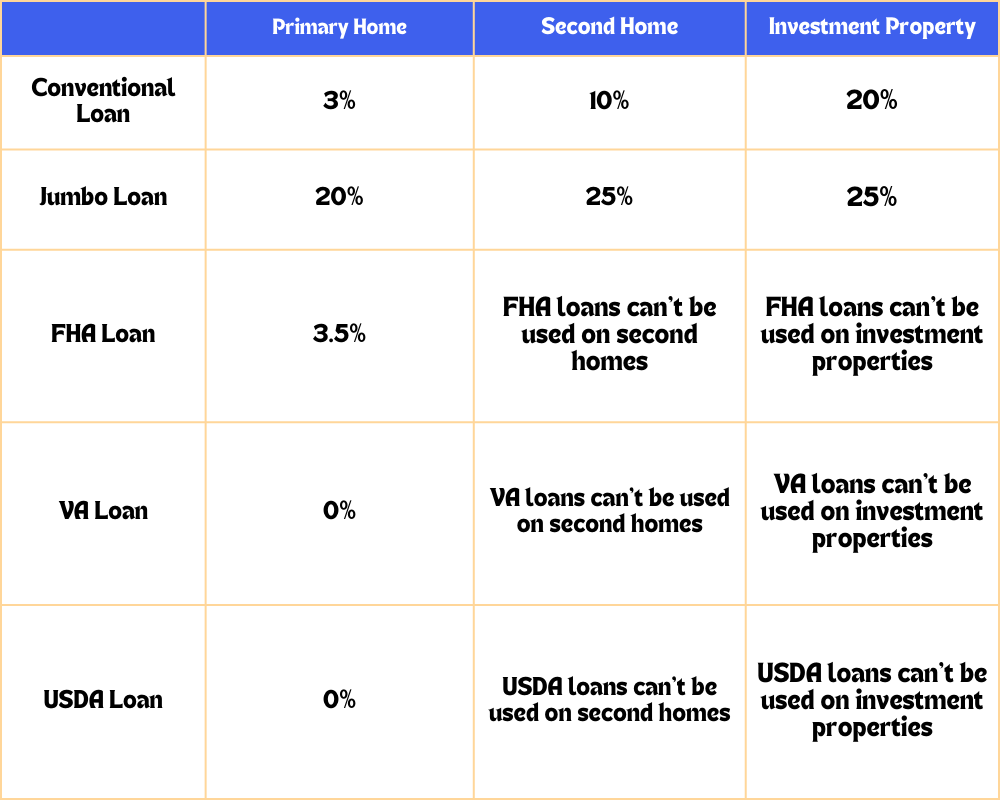
After knowing how much is a down payment on a house, the next thing is what is the minimum down payment for a house. The amount needed as a down payment varies based on both the home type and loan used to buy it, but usually at least 3-5% down is expected from conventional loan customers with typical home buying experiences such as first-timers and those qualifying for programs like HomeReady/HomPossible mortgage programs.
This table lists how much is a down payment on a house, or minimum down payment amounts for major loan types when purchasing either a primary residence, secondary home, or investment property.
Keep in mind: Your lender may require more depending on your credit score, debt-to-income ratio, and overall financial profile.
Alternative Financing Options
Sometimes buyers explore additional options beyond traditional loans:
Assumable Mortgage
With an assumable mortgage in Las Vegas, you may be able to take over a seller’s existing loan, sometimes with a lower interest rate. The required down payment is usually the difference between the home price and the remaining loan balance.
Seller Financing
In some cases, seller financing allows buyers to negotiate flexible down payment terms directly with the seller. This can be helpful if traditional loan qualification is challenging.
These options depend on availability and qualification, but they can reduce upfront cash requirements in certain situations.
How Much Difference Does a Larger Down Payment Make?
Example on a $350,000 home:
- 5% down = $17,500
- 20% down = $70,000
- Loan difference = $52,500
Depending on your interest rate, this could lower your monthly payment by approximately $250–$400 per month, plus savings from avoiding PMI.
Exact savings depend on your loan terms.
Average Down Payment in 2026
Recent housing data shows:
- First-time buyers often put down 6%–10%
- Repeat buyers average 15%–20%
- Some buyers qualify for 0% down programs
There is no one-size-fits-all number. The right down payment depends on your goals and comfort level.
Don’t Forget Closing Costs
Your down payment is separate from closing costs.
Closing costs usually range from 2% to 5% of the home price and may include:
- Loan fees
- Title insurance
- Appraisal fees
- Property taxes
- Escrow setup
Make sure you budget for both.
Factors To Keep In Mind While Considering How Much Is A Down Payment On A House:
Consider these factors when determining how much is a down payment on a house:
- How much cash do I need for the closing process? Depending on your upfront expenses such as closing costs, prorated taxes, and title fees. Cash may be needed as early as three to six weeks out from closing day!
- Have you allocated money towards home maintenance and upkeep expenses? To reduce ongoing homeownership expenses, set aside some savings each month for maintenance costs.
- Will Your New Home Need Repairs and Upgrades? After moving into a home, it may require repairs or enhancements that you wish to make in terms of upgrades or modifications.
- Do You Qualify for Down Payment Assistance? There may be assistance programs available that could cover some or all of your down payment costs.
How To Get A Down Payment For A House?
63% of mortgage buyers reported saving over time to meet a down payment on a house, with 46% using proceeds from selling previous residences.
Saving for a down payment takes time and discipline, yet some first-time home buyers have found success using innovative means such as taking on side gigs or setting aside tax return income every year as savings for their down payment. More traditional means include financial gifts from loved ones as well as selling stocks or investments like retirement funds or cryptocurrency to cover it all.
Frequently Asked Questions
If you have any more questions related to how much is a down payment on a house, contact Las Vegas real estate agents now!
Richard Slezak, Las Vegas Realtor®

Agent License: S.0201790
Call: (702) 688-3508
MAIL: richardslezak@gmail.com
Address: 2298 W Horizon Ridge Pkwy #114, Henderson, NV 89052, USA


Join The Discussion